The Black Atlantic Needs a Revival: How the Avant Garde Subverts Paul Gilroy’s Nationhood and Race Relations
An art curator for Tate Modern London, Tanya Barson explores Paul Gilroy’s seminal text, The Black Atlantic: Modernity and Double Consciousness, by curating an exhibition on alternative interpretations of the Transatlantic Slave Trade within the contemporary culture of the 20th century. The production of Afro Modern: Journeys Through the Black Atlantic, presented over 140 works to reflect on “[…] the Atlantic Ocean as a ‘continent of negative,’ a network of cultures connecting Africa, North and South America, the Caribbean and Europe, and traces the real and imagined routes taken across the Atlantic from 1909 to today15.” From Pablo Picasso to Edouard Glissant, the migration of culture through the Atlantic is examined through “a multiplicity of modernisms, rather than one single, core narrative16,” as Gilroy’s conception of counter-modernity sparks debate on race and nationhood. The aim of my argument is to suggest that the modernisms of Avant Garde art within Barson’s Afro Modern exhibit, politically and culturally challenge Paul Gilroy’s disregard of black women in The Black Atlantic, at the defence of patriarchal systems.
For the last two centuries, the technique of Avant Garde was radically political and influenced early on by socialist conceptions. The style followed the political uprising of The French Revolution, The Russian Revolution, and World War I to capture an individual invoking resistance through art. The pervasive manner of artistic design opposed the fanatical, the utopic, to “[…] soberly examine the terms of history and of cause and effect the antecedents, justifications and functions of the forms that lie at the heart of every society17.”
Paul Gilroy’s utilization of male, academic figures to clarify his concept of counter-modernity are apparent. W. E. B. DuBois’s theory on Double Consciousness, quotes from Edouard Glissant, Sander Gilman and Henry Louis Gates Jr. within their concept of modern cultural axiology, Salman Rushdie’s Satanic Verses, and the common figures of Nietzsche, Freud, and Hegel, conceive a theory on race, for men and by men. In a 1996 Review of The Black Atlantic, Madhavi Kale argues the limitations of Gilroy’s theoretical counter-modernity, by centring male academics as reference points of interpretation. The ‘othering’ of black, female writers is evident in the absence of their voice all together. Kale bluntly writes:
Women, however, are present in Gilroy’s black Atlantic largely in their absence. Gilroy’s mediations on masculinity, nationalism, and modernity might have looked very different if he has considered Linda Brent, Ida B. Well-Barnett or Ann Julia Cooper, and Dorthy West along with or instead of Fredrick Douglass, W.E.B DuBois and Richard Wright. […] the cultural absolutist and American exceptionalist tendencies he discerns might not have appeared as monumental as he makes them in The Black Atlantic18
The ‘ethically absolute, culturalist racism’ Gilroy objects too, becomes increasingly muddled by the repetitive exclusion of black women in his analysis of the Transatlantic Slave Trade, African diaspora and cultural politics of race to explicate his counter-modernity proposition. Moreso, the absolutist perspective Gilroy expands upon is two-fold, through the remnants of DuBois’s double consciousness by only considering race and nationality, alleviating the third proponent of gender amidst institutional patriarchal systems as relevant or substantial to his claims. The black body becomes culturally relevant in so much the speaker is explicitly regarded as male and absently assumed as female.
Yet, Tanya Barson’s exhibit on the Afro Modern suggests that black female subjectivity has not been subverted as easily within artistic construction. Pieces like ‘Le Paradis des Nègres Variete’ (1929), ‘The Door (Admissions Office),’ (1969) and ‘Venus Baartman’ (2001) argue toward a conversation on race which must include the female body. A presentation of nudity, political campaigns, nature, and culture formulate a parallel argument to Gilroy; the representation of race is inextricably linked to gender as it is to nationhood. Even further is Lorraine O’Grady’s notable piece, ‘Olympia’s Maid: Reclaiming Black Female Subjectivity,’ whose unprecedented cultural criticism argues for ‘a reclamation of the body as a site19’ on black, female subjectivity. O’Grady goes on to write:
It is the African female who, by virtue of colour and feature and the extreme metaphors of enslavement, is at the outermost reaches of “otherness” and yet, she continues, ‘the black female’s body needs less to be rescued from the masculine “gaze” than to be sprung from a historic script surrounding her with signification while at the same time, and not paradoxically, it erases her completely20
The ‘historic script’ O’Grady postulates are patriarchal institutions that feed into the ‘masculine gaze’ that has seared, intertwined, and trapped the subjectivity of women altogether. More importantly, if Gilroy were to expand upon DuBois’ theoretical paradigm of double consciousness, by including gender, than the subjectivity of the black female would not once again, succumb to a grotesque ‘othering’ of identity and belonging. Yet, the erasure O’Grady speaks too, fits seamlessly into the counter-modernity Gilroy sought out to invent.
Yet, with the conceptualization of the Afro Modern and the utilization of Avant Garde styles, the black female’s dilemma to critically opposes ‘othering,’ in political, religious, and racialized iconographies, become abundant in such resistance pieces. For instance, Renee Cox’s controversial piece, ‘Yo Mama’s Last Supper21,’ displays the black artist nude, imitating the position of Christ at the dinner table, surrounded by eleven black men and one white Judas. Cox’s subversion of power dynamics begins with gender, as she replaces the male figure of Christ, overtly standing and centred, while nude in the room full of clothed men. A white piece of fabric litters her outstretched arms to signal the ideological sign of purity male priests are adorned in, while also diminishing social expectations to cover her body. It is clear, that the subversion of her subjectivity as a woman, is displayed by renouncing the sexualized objectification of the female body throughout history, by starting at the religious genesis for many, The Last Supper. O’Grady speaks to the nude of the black female body, arguing, “[…] [it] addresses the traditional aesthetic unworthiness or invisibility of the black female nude by offering, ‘a paradigm for the willingly to look, to get past embarrassment and retrieve the mutilated body.22” Even further, the black female Christ must be attended to by the viewer as a focal point of the painting. Her presence elicits biblical metaphors of sacrifice, as wine and offerings scatter the table. The sacred iconography of the cross illuminates either side of the background, to push her lengthened arms as their own allegorical cross. She becomes Christ, explicitly, while also achieving individuality implicitly through stance alone.
Amid controversy toward her piece, Cox defended the right to sustain the artwork within the New York art gallery, arguing, “I have a right to reinterpret the Last Supper as Leonardo Da Vinci created the Last Supper with people who look like him. The hoopla and the fury are because I’m a black female. It’s about me having nothing to hide23.” Moreso, the right to interpret or remake art as a cultural resistance has become fundamental to counteracting a racialized historicity and the modern affliction of subjectivity as seen within Afro pessimism. As the Avant Garde posits a stage to exhibit the cultural and political discourse, it also allows the artist “[…] to publicly review and interrogate that very history of exclusion and racism,24” they experienced within a past and present lense.
Overall, Gilroy’s dependence on a nonlinear approach to modernity explicate bigger issues with inclusivity and intersectionality within black studies. His preoccupation with race and nationality become futile as the black, female subject lacks equal rights in the same country, unidentifiable within the historicity of slavery, and excluded in the same conversations on race altogether. At present, if counter-modernity is to be noted as a liberation from racist or absolutist attitudes, then the hybridity and transnational culture he postulates as a feasible resolution is only as good if the black female subject is initially remembered.
Bibliography:
Cox, Reene, ‘Yo Mama’s Last Supper,’ Renee Cox, 2021, <https://www.reneecox.org/yo-mamas-last-supper>
Greenberg, Clement, ‘Avant-Garde and Kitsch,’ in Art and Culture: Critical Essays, Beacon Press Boston, 1961, pp. 3-22.
Kale, Madhavi, The Black Atlantic: Modernity and Double Consciousness, by Paul Gilroy, Social History, vol. 21(2), 1996, pp. 252–56, <http://www.jstor.org/stable/4286351>.
O’Grady, Lorraine, Olympia’s Maid: Reclaiming Black Female Subjectivity, Afterimage 20, no. 1, 1992
Tonya Barson and Peter Gorschluter and Petrine Archer Straw, Afro Modern: Journeys through the Black Atlantic, Tate Publishing, 2010.
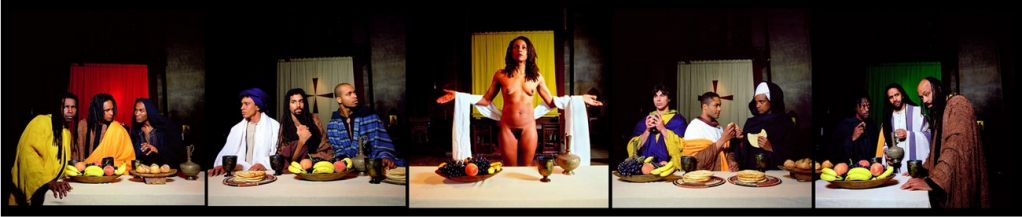
Yo Mama’s Last Supper, 1996

